

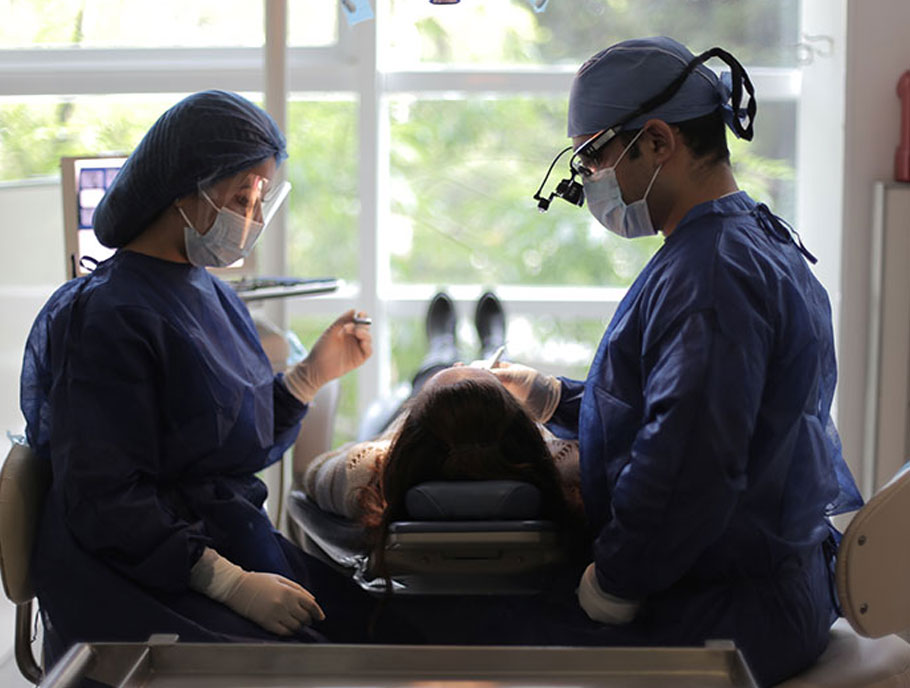
Oral health care contributes to the proper functioning of the body while also having an impact on the individual’s confidence and self-esteem.
WHAT DOES A PROFESSIONAL DENTIST DO?
Our graduates are health professionals who perform prevention, diagnoses and prognoses, as well as conducting treatment plans for oral diseases. All the while, they procurethe health and aesthetics of the stomatognathic system and the patients’ comprehensive health.
Recognition decree by the Mexican Department of Public Education: No. 2002180
ACCREDITATION
Accredited by the National Council of Dental Education (CONAEDO).
https://www.conaedo.org.mx/
Academic program approved by the Dental Board of California since 2002.
MISSION AND VISION
We are a lasallian institution committed to offering cutting-edge, comprehensive education for future Dental professionals, who stand out for their righteous, critical, truth-seeking generation of knowledge. As a result, our graduates contribute to safeguarding the health and well-being of both individuals and society as a whole.
Vision
We are recognized as a lasallian educational institution focused on dentistry, reputed for its academic quality, its contextualized international scope, and its articulated processes, which take place in a harmonic, hopeful, fraternal environment.
If you complete our Dentistry program, you will be able to find work both in the public and the private sectors, in health institutions, hospitals and dental clinics, as a general dentist, a researcher or an oral health services manager.
In addition, you will be skilled enough to start your own private practice dental office. You will also be able to work at research centers, universities and educational institutions as a professor or as an office employee.
Our campus has all the facilities necessary for the development of our academic programs, including:
Required Knowledge
Skills
La Sallian Values
Attitudes
Our graduates shall distinguish themselves for having the following skills:
1. Thinking Skills Field
1.1 Applies critical thinking and problem-solving skills to evidence-based dental care, while taking into consideration emerging trends, scientific literature, research projects participation, clinical experience, as well as the characteristics and needs of patients or the corresponding population group.
2. Professional Ethics Field
2.1 Shows professionalism when practicing dental care with the purpose of promoting, maintaining or recovering health while respecting ethical and deontological principles, human rights, and the current health standards and regulations.
2.2 Practices general dentistry with self-criticism and with multidisciplinary interaction alongside other professionals in order to foster comprehensive health care.
3. Communication and Interpersonal Skills Field
3.1 Interacts with patients, collaborators, and health professionals, among others, by promoting a collaborative leadership for the provision of health services focused on patient care through the application of the fundamental principles of behavioral sciences and of interpersonal skills.
3.2 Succeeds at communicating with patients, collaborators, and health professionals, among others, to ensure inclusion and respect for diversity in primary care of oral health within a multicultural work environment.
4. Health Promotion Field
4.1 Promotes prevention, intervention and education with the purpose of developing healthy lifestyles by reducing risk factors related to oral diseases and epidemiology; and by taking into account needs, characteristics, socioeconomic and cultural conditions, as well as patients with special needs.
4.2 Participates proactively with members of the dental team as well as other professionals to manage and promote health in both private and communitarian dental practice environments.
5. Health Management and Information Technologies Field
5.1 Applies information technologies to patient care and follow-up within the framework of health services by taking the medical context and the patient's characteristics into consideration.
5.2 Uses current management models to promote primary oral health care suitable for the needs of the population, thus providing collaborative leadership.
5.3 Applies adverse-event and risk-management protocols to proceed adequately when providing oral care, by taking clinical record information and validity into account as determined by local, state, national, and international regulations.
5.4 Applies quality, business management, finance, human talent, and sustainability principles to dental practice, drawing on demographic and socioeconomic trends, as well as on continuous improvement goals.
6. Patient Care Field
6.1 Provides oral health services on the basis of biomedical sciences, the latest scientific evidence, and numerous specific guidelines for general dentistry for children, teenagers, adults, geriatric patients, and/or patients with special needs.
The curriculum, each of the courses that it is composed of, the specific objectives of those courses, and the teaching-learning activities conducted by the members of our faculty all contribute to the development of these skills.
a. Performs diagnoses, prognoses, and treatment plans by adhering to the stages of the clinical diagnosis method: questioning, intra and extraoral examination of soft and hard tissues of the head and neck, running or integrating complimentary tests, and cross-consultation with specialists of a variety of medical and dental areas in order to restore, promote, and/or maintain health.
b. Applies knowledge of biomedical sciences to provide patient care.
c. Implements universal biosafety, biocontainment and infection control directives to minimize biological contamination risks before, during, and after oral and dental care.
d. Recognizes evidence of medical negligence in the practice of oral and dental care.
e. Continually promotes preventive actions and strategies to maintain the health of the individual by working in conjunction with other complementary disciplines within conventional and non-conventional practice environments with the goal of fostering health and self-care habits.
f. Performs a variety of effective intraoral local anesthesia techniques in compliance with pharmacological and non-pharmacological protocols to treat anxiety, and acute, chronic, orofacial and dental pain.
g. Conducts direct restorative procedures on dental organs to restore the shape, function, and aesthetics of the stomatognathic system.
h. Manages dental lab procedures for patient care.
i. Conducts oral rehabilitation procedures according to the fundamentals of fixed prostheses and removable partial or complete dentures in order to restore the patients’ shape, function, optimal occlusion, and aesthetics.
j. Participates in performing diagnoses, referrals, and dental implant treatment follow-ups alongside multidisciplinary teams working within a general dentistry framework.
k. Provides periodontal care in accordance with anatomo-functional and pathological principles, which allow for the prevention of both the onset and the progress of periodontium diseases. Identifies possible peri-implantitis and refers the patient to the right specialist.
l. Conducts pulp and periradicular therapy to the extent of his or her own capacity.
m. Conducts exodontia procedures and participates in soft and hard tissue therapy as a surgical assistant, as part of multidisciplinary teams working within the framework of general dentistry.
n. Applies protocols in both medical as well as in oral and dental emergency care, in basic life support (CPR), and, if needed, in referring the patient to the right health professional.
o. Spots occlusal anomalies of the stomatognathic system, as well as the main TMJ disorders in patients, with the goal of managing logistics and referring the patient to the right specialist.
p. Evaluates and follows up on the comprehensive dental care results.
In addition to this, the School of Dentistry emphasizes eight defining attributes of our graduates:
Objectives
To train professionals who are capable of evaluating, diagnosing and classifying oral and systemic diseases in humans, in order to develop comprehensive treatment plans that restore the function and aesthetics of the stomatognathic system.
What is the class schedule?
Morning schedule during the 1st and 2nd semesters.
Morning/afternoon schedule from the 3rd to the 8th semester.
How long does it take to complete the program?
Eight semesters, plus a year of mandatory internship (in Mexico).
If you choose to pursue the dual degree program, bear in mind that you will have to complete a 9th semester, upon prior admission.
What courses will you study?
1st semester
2nd semester
3rd semester
4th semester
5th semester
6th semester
7th semester
8th semester
9th semester

P: (477) 719 76 00 Ext. 7201
Dr. José Luis Castellanos Suárez
Academic Head of the Program (CIRO)





Valoramos tu opinión.
Si tienes recomendaciones para mejorar el sitio, por favor compártelas con nosotros.